
Why Do Screw Jacks Have Both Fast and Slow Reduction Ratios?
2026-06-05 10:10:10
Click:
“
A screw jack is a deceptively simple device. It converts rotary motion into line
”
A screw jack is a deceptively simple device. It converts rotary motion into linear motion through a worm gear and a trapezoidal lead screw. But here's the thing: the same jack comes in two speed variants — fast and slow. This isn't redundancy. It's a fundamental trade-off between speed, force, and safety.
The Core Formula
Everything comes down to one equation:
Lifting Speed = Motor RPM ÷ Worm Gear Ratio × Lead Screw Pitch
The worm gear ratio is the key variable. Change it, and you change everything.
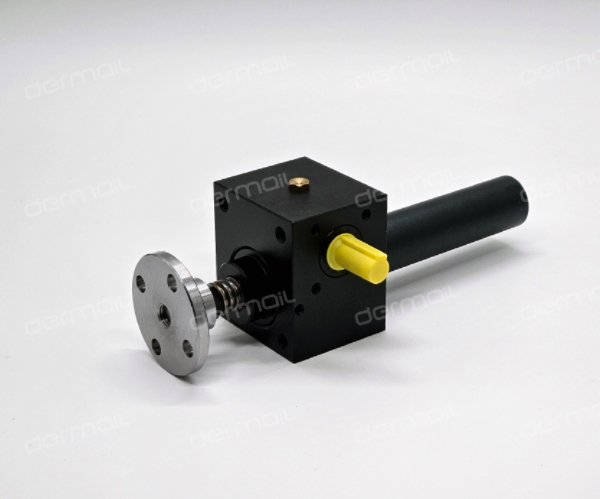
Fast Ratio (e.g., 1:10)
A small reduction ratio means the output shaft spins relatively fast. The platform rises quickly, which is great for high-frequency, light-load applications. But there's a catch: the torque multiplication is modest, so the lifting capacity is lower. More critically, the worm gear's lead angle is larger, pushing the mechanism closer to its self-locking threshold. Under heavy loads, the jack can lose self-locking capability — meaning the load could drop if power is cut.
Slow Ratio (e.g., 1:40)
A large reduction ratio slows the output dramatically. The platform moves slowly, but the torque multiplication is massive — often four times that of the fast variant. The lead angle is much smaller, making self-locking extremely reliable. Even if the motor dies, the load stays exactly where it is. This is why dermail transmission slow-ratio jacks are standard in medical tables, stage lifts, and heavy industrial positioning.
The Trade-Off in Plain Terms
| Fast Ratio | Slow Ratio | |
|---|---|---|
| Speed | High | Low |
| Force | Lower | Much higher |
| Self-locking | Marginal | Rock-solid |
| Best for | Light duty, frequent cycles | Heavy duty, safety-critical |
The Bottom Line
There is no single ratio that gives you both speed and safety. The fast variant trades security for efficiency. The slow variant trades speed for force and absolute positional safety. Choosing between them isn't a preference — it's dictated by what the application actually demands.








Tel:+86-317-7369999
E-mail: demai@demai.org
Mobile:+86-18653450543 (Wechat)
Address:No. 6, Haihe Road, economic development zone, Wuqiao County, Cangzhou City, Hebei Province

点击右上角
分享给朋友吧
Copyright ©2023 All Rights Reserved Hebei Demai Transmission Machinery Co.,Ltd.
Copyright ©2025 All Rights Reserved Hebei Demai Transmission Machinery Co.,Ltd.
