
Common Faults of Screw Jacks and Their Solutions
2026-05-26 08:48:49
Click:
“
Screw jacks are widely used in industrial lifting, positioning, and pressing applications due to their high load capacity, compact structure, and self-locking capability.
”
Screw jacks are widely used in industrial lifting, positioning, and pressing applications due to their high load capacity, compact structure, and self-locking capability. However, like all mechanical equipment, they are prone to various faults during long-term operation. Understanding these faults and their root causes is the first step toward effective maintenance. This article covers the most common problems encountered in screw jacks and provides practical solutions for each.
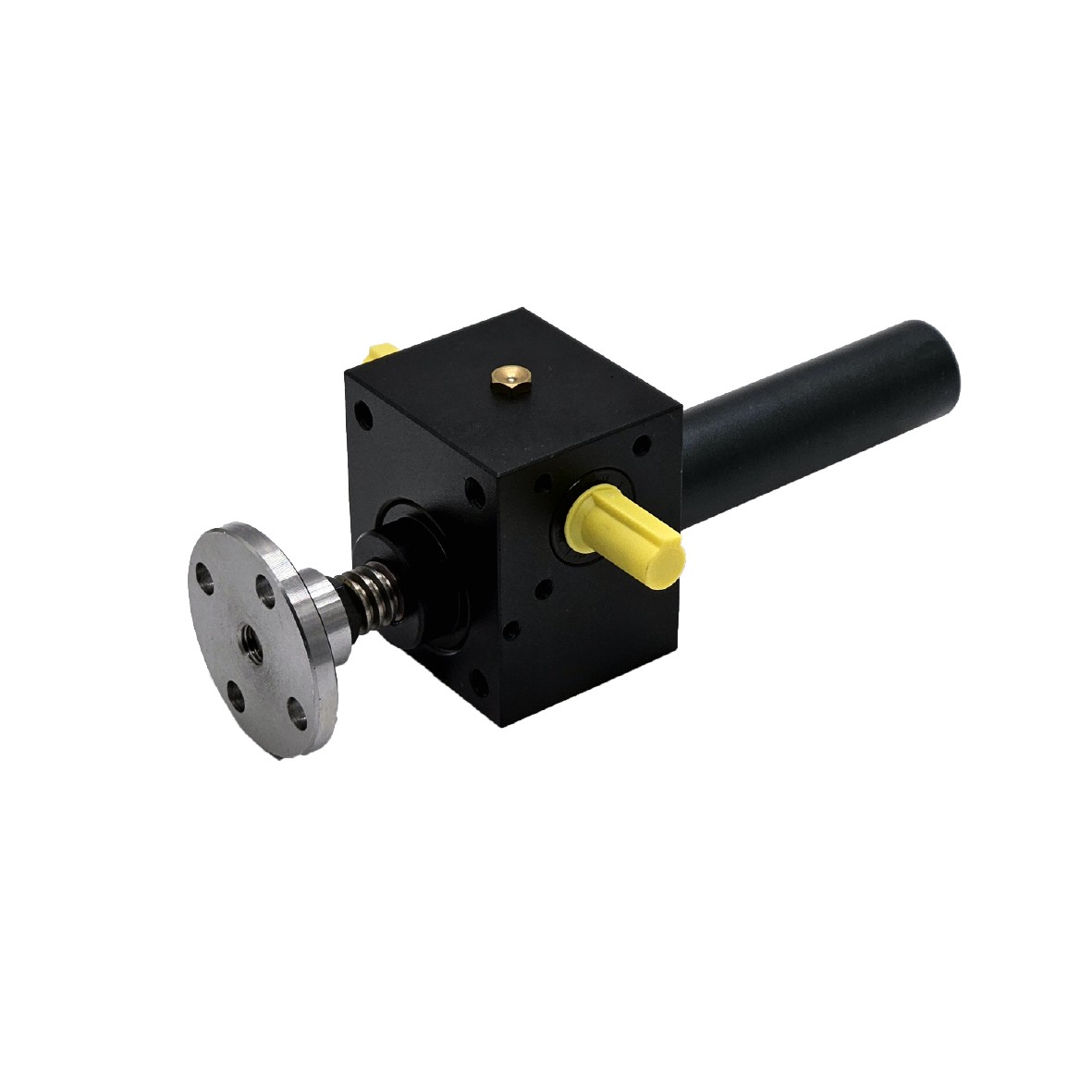
1. Excessive Noise and Vibration During Operation
Symptoms: Unusual grinding, rattling, or humming sounds during lifting or lowering. Vibration may be felt through the mounting base.
Root Causes:
Wear of the worm gear and worm wheel is the most frequent cause. Over time, the tooth profile degrades, leading to increased backlash and impact noise. Insufficient lubrication accelerates this wear dramatically. Another common cause is misalignment between the input shaft and the screw jack body, which creates uneven loading on the gear mesh. Loose mounting bolts can also amplify vibration.
Solutions:
Inspect the worm gear and worm wheel for pitting, scoring, or excessive backlash. Replace the gear set if wear exceeds allowable limits. Ensure the input shaft is properly aligned using a dial indicator, with radial runout kept below 0.05mm. Tighten all mounting bolts to the specified torque. Apply the recommended lubricant at the correct intervals. For worm gear screw jacks, synthetic gear oil with EP additives is preferred, while grease-lubricated models should use lithium-based grease rated for the operating temperature.
2. Overheating
Symptoms: The housing temperature rises significantly above ambient, sometimes exceeding 80 degrees Celsius. The lubricant darkens or emits a burning smell.
Root Causes:
Overheating is almost always a lubrication problem. Insufficient oil volume, wrong oil viscosity, or contaminated oil increases friction and generates excess heat. Overloading beyond the rated capacity forces the gear mesh to operate under extreme stress, producing heat far beyond normal levels. Continuous operation without rest periods compounds the problem, especially at high duty cycles.
Solutions:
Check the oil level immediately and top up with the correct grade of lubricant. For worm gear jacks operating above 60 degrees Celsius ambient, switch to a higher viscosity oil. Verify that the applied load does not exceed the rated capacity, including any dynamic or shock load factors. Implement a duty cycle that allows the jack to cool down between operations. A general rule is to limit continuous operation to 30 minutes followed by a 15-minute rest period for heavy-duty applications. Install a temperature sensor on the housing if overheating is a recurring issue.
3. Screw Rod Jamming or Stalling
Symptoms: The screw rod fails to move, either during lifting, lowering, or both. The motor runs but the output shaft does not turn, or the jack moves in jerks.
Root Causes:
Contamination is the primary culprit. Dust, metal particles, or dried lubricant entering the nut or gear housing creates abrasive wear and eventually locks the mechanism. Corrosion of the screw rod surface, especially in humid or chemical environments, increases friction to the point of seizure. Excessive side loading bends the screw rod, causing it to bind against the nut. In worm gear jacks, a broken or worn worm gear can also cause stalling.
Solutions:
Install protective bellows or boots on the screw rod to keep contaminants out. Clean the nut and screw threads thoroughly and reapply fresh lubricant. If corrosion is found, replace the screw rod and treat the housing with anti-corrosion coating. Check for side loads and add external guide rails or linear bearings if the application involves any off-axis force. Never use a screw jack as a structural support for lateral loads. Inspect the worm gear set and replace if teeth are damaged.
4. Excessive Backlash and Positioning Inaccuracy
Symptoms: The output position shifts when the load is removed or reversed. The jack does not hold its position precisely, and repeated positioning shows increasing error.
Root Causes:
Wear in the worm gear and nut thread is the main cause. As the tooth profile and thread pitch degrade, clearance increases, allowing the output to drift under load reversal. Thermal expansion during prolonged operation can temporarily worsen backlash. In ball screw jacks, ball recirculation path wear or ball loss contributes to positioning drift.
Solutions:
For worm gear jacks, adjust the worm gear axial position to reduce backlash within the manufacturer's specified range. If adjustment no longer helps, replace the gear set. For ball screw jacks, check the ball nut for wear and replace if the axial play exceeds 0.02mm. Use a preloaded ball nut in precision applications to eliminate backlash entirely. In all cases, verify that the load is applied axially and that no side forces are acting on the screw rod, as side loads accelerate wear on the nut and degrade positioning accuracy.
5. Lubricant Leakage
Symptoms: Oil or grease is found around the input shaft seal, the screw rod exit point, or the housing joints.
Root Causes:
Seal degradation due to age, heat, or chemical attack is the most common cause. Overfilling the housing creates internal pressure that forces lubricant past the seals. Using the wrong seal material for the operating environment, such as nitrile rubber in high-temperature applications, leads to premature hardening and cracking.
Solutions:
Replace seals with the material recommended by the manufacturer. For high-temperature applications, use fluorocarbon (Viton) seals. For chemical environments, use PTFE-based seals. Never overfill the housing; follow the fill line marked on the jack. If leakage persists after seal replacement, check the housing for cracks or casting defects. Apply a thin coat of sealant on the housing joint flange as a temporary measure, but do not rely on sealant as a permanent fix.
6. Self-Locking Failure
Symptoms: The screw jack lowers under load when the motor is turned off, or the load creeps downward during holding.
Root Causes:
Self-locking in worm gear screw jacks depends on the lead angle of the worm being smaller than the friction angle of the gear mesh. Excessive wear on the worm gear teeth increases the effective lead angle, destroying the self-locking condition. High temperatures reduce the friction coefficient, also compromising self-locking. Contamination that acts as a lubricant between the gear teeth has the same effect.
Solutions:
Inspect the worm gear set for wear. If the gear is worn, replace it immediately, as a worn gear set will never self-lock reliably regardless of other adjustments. Ensure the operating temperature stays within the rated range. Keep the gear mesh clean and properly lubricated with the correct oil. If self-locking is critical for safety, consider adding an external brake on the motor shaft as a redundant safety measure. Never rely on a worn screw jack for load holding in safety-critical applications.
7. Shortened Service Life
Symptoms: The jack requires frequent maintenance or part replacement well before the expected service life.
Root Causes:
The vast majority of premature failures trace back to three causes: wrong lubricant, overload, and contamination. Using grease where oil is specified, or vice versa, destroys the internal components within months. Operating at even 120 percent of rated capacity can reduce service life by half. Allowing dust, water, or metal chips into the mechanism accelerates wear exponentially.
Solutions:
Follow the manufacturer's lubrication schedule and specification exactly. Use only the oil or grease grade recommended for your operating temperature and duty cycle. Never exceed the rated load, and always apply the correct safety factor, typically 1.5 for dynamic loads and 2.0 for shock loads. Install protective covers and seals to keep the mechanism clean. Keep a maintenance log recording oil changes, load conditions, and operating hours. This data helps predict when components need replacement before failure occurs.
Summary
The table below summarizes the key takeaways.
| Fault | Primary Cause | Key Solution |
|---|---|---|
| Noise and vibration | Gear wear, misalignment | Replace gear set, realign shaft |
| Overheating | Poor lubrication, overload | Correct oil, reduce load, add rest periods |
| Jamming and stalling | Contamination, corrosion, side load | Seal the jack, clean components, add guide rails |
| Backlash and inaccuracy | Thread and gear wear | Adjust or replace worn components |
| Lubricant leakage | Seal degradation, overfilling | Replace seals, correct fill level |
| Self-locking failure | Gear wear, high temperature | Replace gear set, control temperature |
| Shortened life | Wrong lubricant, overload, dirt | Follow specs, respect ratings, keep clean |
Preventive maintenance is always cheaper and safer than reactive repair. A well-maintained screw jack can operate reliably for tens of thousands of hours. The key is to treat lubrication, alignment, and load limits as non-negotiable, and to inspect the equipment at regular intervals rather than waiting for failure to occur.








Tel:+86-317-7369999
E-mail: demai@demai.org
Mobile:+86-18653450543 (Wechat)
Address:No. 6, Haihe Road, economic development zone, Wuqiao County, Cangzhou City, Hebei Province

点击右上角
分享给朋友吧
Copyright ©2023 All Rights Reserved Hebei Demai Transmission Machinery Co.,Ltd.
Copyright ©2025 All Rights Reserved Hebei Demai Transmission Machinery Co.,Ltd.
