
Advantages of Multi-Unit Screw Jack Synchronization Systems
2026-03-18 15:41:43
Click:
“
Screw jacks are widely used in industrial automation, heavy-duty lifting, and precision positioning applications due to their high load capacity, self-locking capability, and precise control.
”
Screw jacks are widely used in industrial automation, heavy-duty lifting, and precision positioning applications due to their high load capacity, self-locking capability, and precise control. However, in scenarios requiring large-scale lifting, ultra-high precision synchronization, or distributed load handling, a single screw jack often falls short. By integrating multiple Screw Jack Systems in a synchronized system, engineers can overcome these limitations while unlocking enhanced performance, reliability, and flexibility. This article explores the key advantages of multi-unit screw jack synchronization systems.
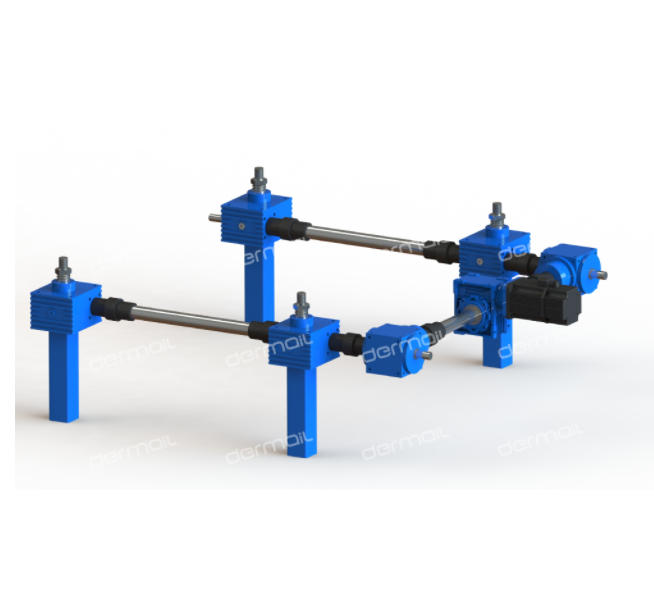
1. Enhanced Load Capacity and Stability
A primary benefit of multi-unit synchronization is the distribution of heavy loads across multiple lifting points. While a single screw jack may struggle with excessive weight or risk deformation under stress, a synchronized system divides the load evenly, preventing overload and ensuring structural integrity.
- Example: In heavy machinery lifting (e.g., wind turbine nacelle maintenance), a 4-jack system can support loads exceeding 50 tons, far beyond the capacity of a single unit.
- Stability Improvement: Multi-jack configurations minimize tilting, vibration, and deflection, making them ideal for precision applications like semiconductor manufacturing or medical imaging equipment adjustment.
2. Ultra-Precise Synchronization for Complex Motion Control
Many industrial processes demand synchronized vertical, horizontal, or rotational movement across multiple axes. Multi-unit screw jack systems achieve this through:
- Mechanical Synchronization: Using coupling shafts, bevel gears, or timing belts to ensure all jacks move in unison.
- Electronic Control: Advanced PLC (Programmable Logic Controller) or servo-driven systems adjust speed and position in real time, maintaining sub-millimeter accuracy even under varying loads.
- Application: In automated assembly lines, synchronized screw jacks lift workpieces to precise heights for robotic welding or inspection, improving throughput and quality.
3. Improved System Reliability and Redundancy
Multi-jack systems offer built-in fault tolerance, ensuring continued operation even if one unit fails:
- Redundancy Design: If a single jack malfunctions, the remaining units can still support the load, preventing catastrophic failure.
- Load Balancing: Smart controllers dynamically redistribute forces, preventing overstress on individual jacks and extending service life.
- Example: In bridge inspection platforms, if one jack loses power, others compensate to keep the platform stable, ensuring worker safety.
4. Flexible Adaptation to Irregular Loads and Spaces
Unlike single-jack setups, synchronized systems can be arranged in linear, circular, or matrix configurations to fit unique workspace requirements:
- Modular Design: Jacks can be positioned at varying angles or distances, accommodating non-uniform loads (e.g., irregularly shaped machinery).
- Scalability: Additional jacks can be integrated as needed, making the system adaptable to future upgrades without complete redesign.
- Application: In architectural facade installation, multiple jacks adjust large glass panels to precise angles, even on curved surfaces.
5. Cost-Effectiveness and Maintenance Efficiency
While multi-jack systems may have higher initial costs, they offer long-term savings through:
- Optimized Component Selection: Using smaller, standardized jacks instead of one oversized unit reduces procurement expenses.
- Simplified Maintenance: Modular jacks are easier to replace or service individually, minimizing downtime.
- Energy Efficiency: Smart controllers adjust power output based on load demands, reducing energy consumption compared to continuous full-power operation.
6. Energy Efficiency and Parallel Operation
Multi-jack systems enable parallel processing, where multiple lifting tasks occur simultaneously, boosting productivity:
- Example: In automated warehouses, synchronized jacks lift multiple storage racks at once, speeding up inventory retrieval.
- Dynamic Load Adjustment: Under light loads, only some jacks operate, conserving energy while maintaining performance.
Conclusion
Multi-unit screw jack synchronization systems represent a superior solution for applications demanding high load capacity, ultra-precision, fault tolerance, and adaptability. By leveraging mechanical and electronic synchronization, these systems outperform single-jack setups in heavy industry, automation, construction, and precision engineering. As industries continue to push the boundaries of efficiency and reliability, synchronized screw jack configurations will remain a cornerstone of advanced lifting and positioning technology.








Tel:+86-317-7369999
E-mail: demai@demai.org
Mobile:+86-18653450543 (Wechat)
Address:No. 6, Haihe Road, economic development zone, Wuqiao County, Cangzhou City, Hebei Province

点击右上角
分享给朋友吧
Copyright ©2023 All Rights Reserved Hebei Demai Transmission Machinery Co.,Ltd.
Copyright ©2025 All Rights Reserved Hebei Demai Transmission Machinery Co.,Ltd.
